![_[流言板]塔帅:拉玛西亚塑造我的足球观,确保一切都正确对我很重要_[流言板]塔帅:拉玛西亚塑造我的足球观,确保一切都正确对我很重要](/wp-content/uploads/2026/05/1777623516159_0.webp)
Hupu announced on May 1 that the documentary series "The Art of Details" officially produced by Arsenal has been updated with the second episode. This episode focuses on the team's head coach Mikel Arteta.
Questioner: Your time in Spain must have started in La Masia. It has been described as a unique and exciting place. Can you tell us about it?
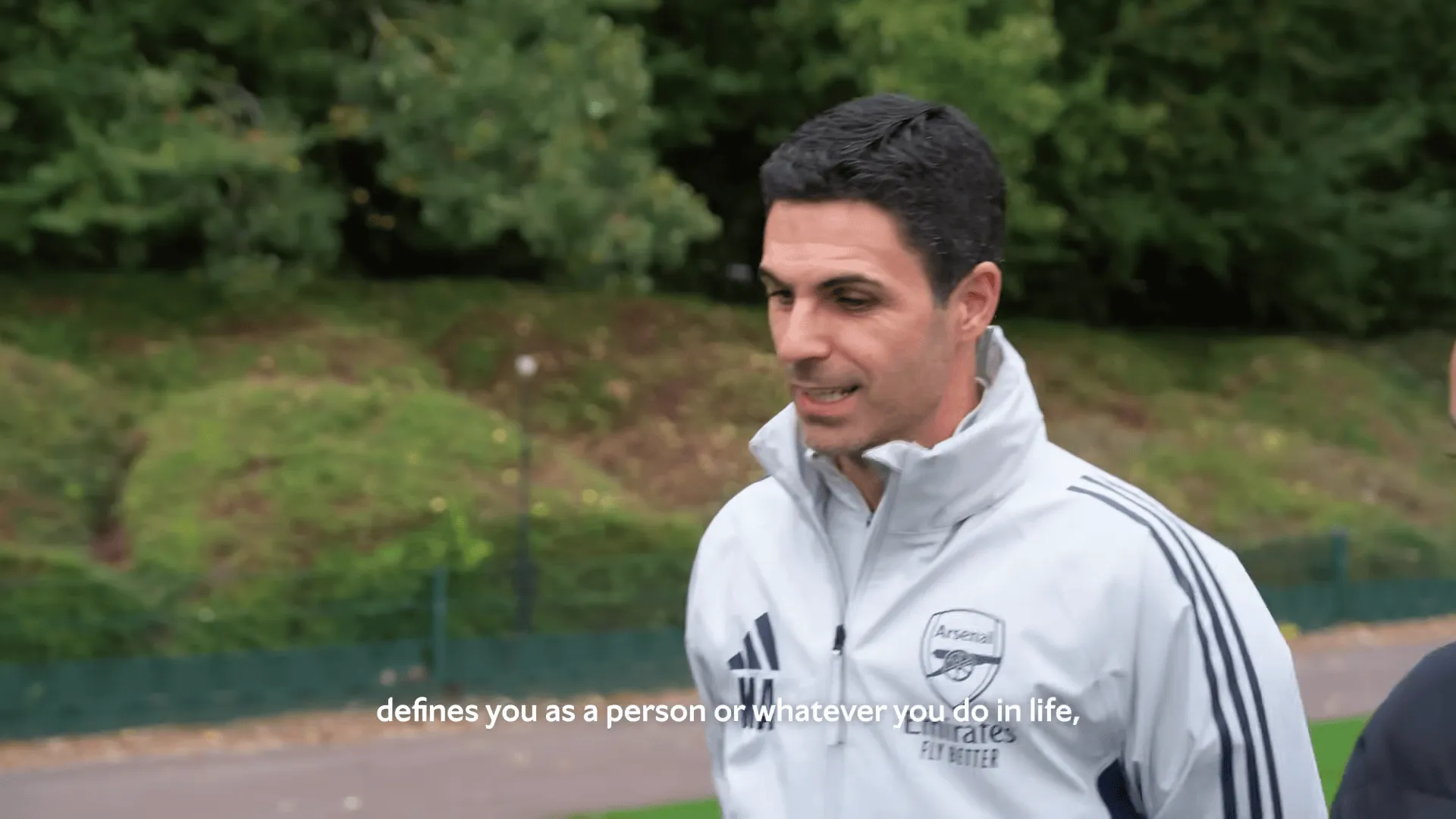
Arteta said, "I think the environment and the people in the environment shape who you are as a person and also shape everything you do in life. It was a very special environment. What made it unique was that they recruited probably the best talent in Spain at the time and put us all together.
Luckily for me, I spent those two and a half years with probably the best people in the world that I could pick if I were to pick, and over the next 20 years they became superstars. There are Pepe Reina, Victor Valdes, Andres Iniesta, Xavi, Puyol…just these names, all in the same house.
So you can imagine that that experience most likely shaped my approach to the profession and how much I learned from some of the most amazing people at that time.
Moderator: I think it must be very competitive. After all, each of you knows your goals and the height you expect to reach. But what impact would being in that environment have on your growth as a young boy?
Arteta said, yes, I was fourteen years old at the time. It was the first time I left my hometown of San Sebastian. It was 600 kilometers away from home. You are thrown into that place and you have to survive. Like you said, it's unique because it's so competitive, but at the same time, that's where I learned about teamwork and looking out for each other.
We can compete, but we also have to cooperate, we have to take care of each other, and we have to really think about, "How can I make the person next to me better?" The reason is that we all have such a significant impact on each other's emotions. We go to school together and do many activities together. We need each other.
At the age of fourteen, in a very different place, in a huge city, in a place with extremely high expectations, you will feel an extremely strong sense of loneliness, and I feel that this has built a great platform for my future career.
Host: Is that where you first came into contact with Johan Cruyff?
Arteta: Yes.
Host: What impact did he have on you?
Arteta said that for John, it was more about the things he had built, the history he had and the way he thought about the game, rather than him because I had only met him twice.
However, in fact, the way he thinks about the game and the philosophy he implements in Barcelona is a firm belief from top to bottom. This is a way of observing the game and playing the game, and it will penetrate into your body.
Once you understand why he's doing what he's doing and the way he's doing it, it all clicks together and I think that's very powerful in a football club and it becomes very powerful given the nature of the team.
The host asked, do you think there are some things there that are similar to what you have built here (Arsenal)?
Arteta said that there are some similarities, but in comparison they are very different and the cultural differences are huge. He felt that the opportunity we once had was to live together day and night, but here, we do not have that possibility.
That sense of belonging is something that I feel in the club, in the academy and in the history of the club, it's very, very similar, but some of the rules in this country don't allow for that environment to be created.
Host: As the father of a teenage boy, when you see those young people who have grown up through the youth training system – like Max Dowman, Miles Lewis Skelly, and many others we can list – do you feel a sense of pride in your heart when you look at them?
Arteta said that there is a huge sense of pride, but there is also a huge sense of responsibility. This is because he has gone through that process. He has played for nearly 16 or 176 years, starting from Barcelona's G team, which is the seventh level, to playing in the Champions League not long after joining Paris. This is the case.
People don't realize the consequences of putting a player at this level, given that the entire environment has changed. They have different schedules and different responsibilities. The media is watching them closely, and the expectations you have on them emotionally and physically are huge, and the financial impact is huge.
You're leaving your comfort zone, you're leaving your family, you don't have friends, and you have to earn the trust of the team, earn the trust of the coach, earn the trust of the entire fan base, and they're going to ask questions, and they're going to ask, "Who is this guy? Can he help us?" So, building trust among all of these elements requires a lot of detail and care.
So, I'm filled with pride just because we have some players right now who have truly been ours from the get-go, but at the same time, there's a huge sense of responsibility to do the right thing for them and not rush things and give them the right exposure.
Host: When you came here as the head coach, did everyone talk about how you shaped the culture and created the environment? However, at the same time, you really focused on making this place have a family atmosphere, and why family is so important!
"We have a goal that whoever walks through the door, whoever comes to any facility or anywhere associated with the club, carries that energy with them," Arteta said. He wants every time you walk through those doors to feel like, "Wow, I'm so proud of this."
I am part of this part of history and I think that means who I am and what I have contributed to the history of this club. "Then we can build on that foundation. That's the main goal.
Culture means creating an environment where everyone can be themselves, because we have so many different cultures that need to be integrated into a whole that everyone can take pride in, enjoy and take responsibility for. If you achieve this, we'll have a pretty good place that provides yourself with the opportunity to have a job every day.
Host: Do you have any non-negotiable principles that go along with these values?
Arteta said, yes, there are many. For me, the most critical thing is the passion we have for what we do. You must have passion. If you don't have the passion to be part of this football club, to play football and to fulfill any of your roles here, then you're in the wrong place. If you have it, you have an opportunity.
For yourself, there is respect, and you need to understand that there is such a part. It is mostly about what you want to do with your career, life and motivation. However, there is also a category of "we", which is about what you want to achieve as a club or team. In addition, there is another important point, that is, you must take responsibility for your own responsibilities.
If the standards are fairly high and the rules are OK, then there is always a possibility. However, it must be standards that drive culture. When standards are high enough, people will be guided by those standards. You don't even have to mention that you are late or your body language, the environment will eventually lead you to behave in a certain way.
Once you lose people's trust it's because if you don't you'll be exposed and people won't trust you.
Host: When I came back here again, even I got new things and learned about what you have to do as a head coach. After all, when I was here as a player, we had olive trees, which I never had during my time here, and there was a lot of background to it. Can you tell me why you brought it here?
Arteta said he has heard a lot when it comes to culture, people and behaviour. So what he did was find people to spend three months talking to everyone in the club, who had different roles, different personalities, and different responsibilities.
How do we individually describe what it's like to "work for us"? You have to use one word to describe it, and then I want to see what the biggest word is. I'm not going to mention that word, because I don't like it, so something has to change.
So I bought a tree, and I own another tree, because this tree symbolizes the foundation of the club, which to me is culture, so it is alive and beautiful, it is extremely beautiful, the roots, vitamins and everything the tree needs are in order and taken care of every day.
From 1886 onwards I always arrived at the club at the same time. This tree is over a hundred years old and we have a duty to care for it. If we take care of it every day, give it water, pleasure, enthusiasm and attention to every detail, it will perform well. The reason is that in this climate and environment, this tree is not in an ideal condition.
This is the thing I gave to deal with – the olive tree, because in any environment if we ignore it, the environment we are in requires a lot of details and needs a lot of attention because it may cause fluctuations.
Sometimes, a storm may come, how do you deal with it? When the sun shines fully and the moisture is sufficient, it is easier and it will be in good condition; however, when strong winds blow and freezing conditions occur, how do we take care of it? Among them, this is a concrete form of expression.
The host said that he likes this because, as you said, the meaning behind it is that every player should know it clearly, and when new people come over, they can actually continue to pass on that story, which is quite special.
Arteta said there were a number of players stretching here and he saw them praying and he saw them touching it. You have to have that sense of belonging to something, and there are many ways to do that. There are many people who have demonstrated the culture and values of this club in their own way. They are extremely valuable and it takes a lot to continue.
Host: Do you have other passions outside the court? Let’s start with exercise.
Arteta said that in terms of sports, the project involved is tennis. When he was a child, he was engaged in tennis until he was 14 years old. To be precise, when he was 14 years old, he had to make a choice between football and tennis.
Host: Really?
"That's what made me so competitive, and then I discarded it, so now I'm playing paddle tennis while I'm still able to participate," Arteta said.
Nowadays, everyone is playing paddle tennis. It is extremely popular in England and many paddle tennis courts are being built everywhere.
"It's interesting because you have that chemistry with your partner, yes, but the fact that you're so close to your opponent creates that competitiveness that I really enjoy and I'm passionate about learning, especially from all these sports and from other coaches, the things that we can implement and make them better," Arteta said.
They are not necessarily tactical, they can be tactical, but they can also be about culture, about methods, about communication, about the activities we can do as a team, about roles within the team, which is predetermined in football but is completely different in other sports.
The relationship between coaches and players is also different. I know that in other sports, they have more responsibility and are not so dependent on the coach. They have more freedom.
Host: Is there anything that you learned playing tennis that made you think, "Yeah, this can transfer to me as a football player," or is it something that you brought into the team?
Arteta said, mental toughness, I put it this way, you know the transition from one score to the next, just three seconds, action after action, a tennis match is won by three points or five points, and after five hours of fierce battle, the difference is only three points or five points, that's it.
You play for five hours, which means how important the next ball is. In tennis, you can't blame anyone, everything depends on yourself. In football, we can say that the coach made a mistake, or the fans are here, the court is not in good condition, or the teammates perform poorly.
In the field of tennis, this situation is actually quite difficult. I hold a view that this is extremely effective in controlling one's emotions and maintaining them in a good state.
Moderator: Good point. After you miss, try again. How do you pass that on to youth players? It's like, "Well, this is training, but looking at it from a holistic perspective, are there other things that can help you become elite?"
Arteta said there are many factors at play in the end, and we try to build what I call a "complete player", that is, a player with high trust and high potential talent.
But this shows that no matter what the situation, you are not only good in one-on-one situations, when you have high trust and high potential, but what about when you are in the stage of being a finisher? Or when you're at a stage where you don't have a game on the weekend and then we start training on Monday morning, what is the standard of training that you're holding to? What exactly are your standards?
In the middle of a meeting, when you need to pay attention to a little detail that might help us win a game, or when you have to tell someone, "This is unacceptable," just building those characters, those personalities, makes everything matter. You can't be super good at one particular thing, because at the level we're at right now, that's not enough.
The host said, you just mentioned the word "terminator". I first heard that it comes from rugby. It is the same situation. In fact, you are not a substitute. You have to change your mentality, and you can achieve the impact of the game after you come on the field. Is this a new term you are using now?
Arteta said, yes, that's what he learned from the "All Blacks" (New Zealand Rugby Team). The reason why he learned it from the "All Blacks" is because the current head coach of the "All Blacks" is a good friend of his and this is something they have been using for many years. There is a difference. In rugby, there are no names on the back of the jersey.
So, as "a jersey", you have a role. No matter what the role is, you have to be at your best to fulfill it. I love this because in those moments when your team needs you the most, the last five minutes, 10 minutes, 15 minutes, 20 minutes of the game, the thing that stops you from being able to perform well is your ego getting in the way in the wrong way.
Ego is great when it serves the team in a powerful way, but it takes away a lot from the team when it gets in the way. We use that term, and the impact the closer has had on every winning team you've seen so far this season has been huge. If we can achieve this, our chances of success will be much higher.
The host said that he knew that the other party also has two hobbies: cooking and reading. He said that he wanted to talk about reading first because the other party just mentioned the "All Blacks". He also said that one of his favorite books, "Legacy", was centered on the All Blacks. He also mentioned that a word he always remembers is "Don't be an energy sucker." Then he asked, people say that the other party is a kind of positive and powerful energy. Where is the source of this energy?
Arteta said it was probably because of the way he was brought up and nurtured and how lucky he was to do what he did that he woke up every morning with the same energy and his wife would ask: "Where are you going?".
At 5 o'clock in the morning, I was anxious and anxious to get here and start work. I saw people here busy preparing the coffee machine and preparing everything for the players who were about to arrive. Supported by love, it is something I do from the bottom of my heart. Look at this environment. We are truly blessed beyond belief.
The host said, I saw a sign in the training center earlier that said "Everything matters." You just mentioned the coffee machine, and it seems obvious to me that everything is really important. Is it that important to you to have state-of-the-art facilities and make sure everything is correct?
Arteta said that's true for him, saying that he's fascinated by these things when he walks, like this net, whether it's tight or loose, and someone did it this morning with all the leaves in the right place.
The way the car park is presented is correct and the cars are clean. If you do it by those standards, you will do it by those standards. I feel like that has a ripple effect on the next person in his role to perform it again with the same passion, the same detail, the same care and love.
The host said, Mikel, thank you for your time. I find that I have learned a lot. I like to learn something after communicating with others. There is a feeling that it makes me grow. If you could tell one more detail about yourself, that is, the thing that you are working hard to improve to become a better coach or a better person, what would it be?
Arteta said, "Maybe it's that "living in the moment", the work we do, the whole industry, the necessity of the moment and situations like winning, which may cause you to slightly deviate from this point in terms of thinking. I realize that I am a poor loser. I am passionate about winning everything in all situations. When I hold the child high, everything shows up…
If the negative impact of losing a game outweighs all the other unimaginable things in your professional life, it is not acceptable. If it causes you to become a different person, have a different way of thinking, and treat others with a different attitude, it is not worth it.
For unfortunate reasons, this is part of what we do, and it's so random and unpredictable. So, do your best to enjoy this work while doing it. Surround yourself with the best people, do this every day, ensure that people are in a state of progress, and give them opportunities to realize their potential. Many other things, hopefully, will follow.