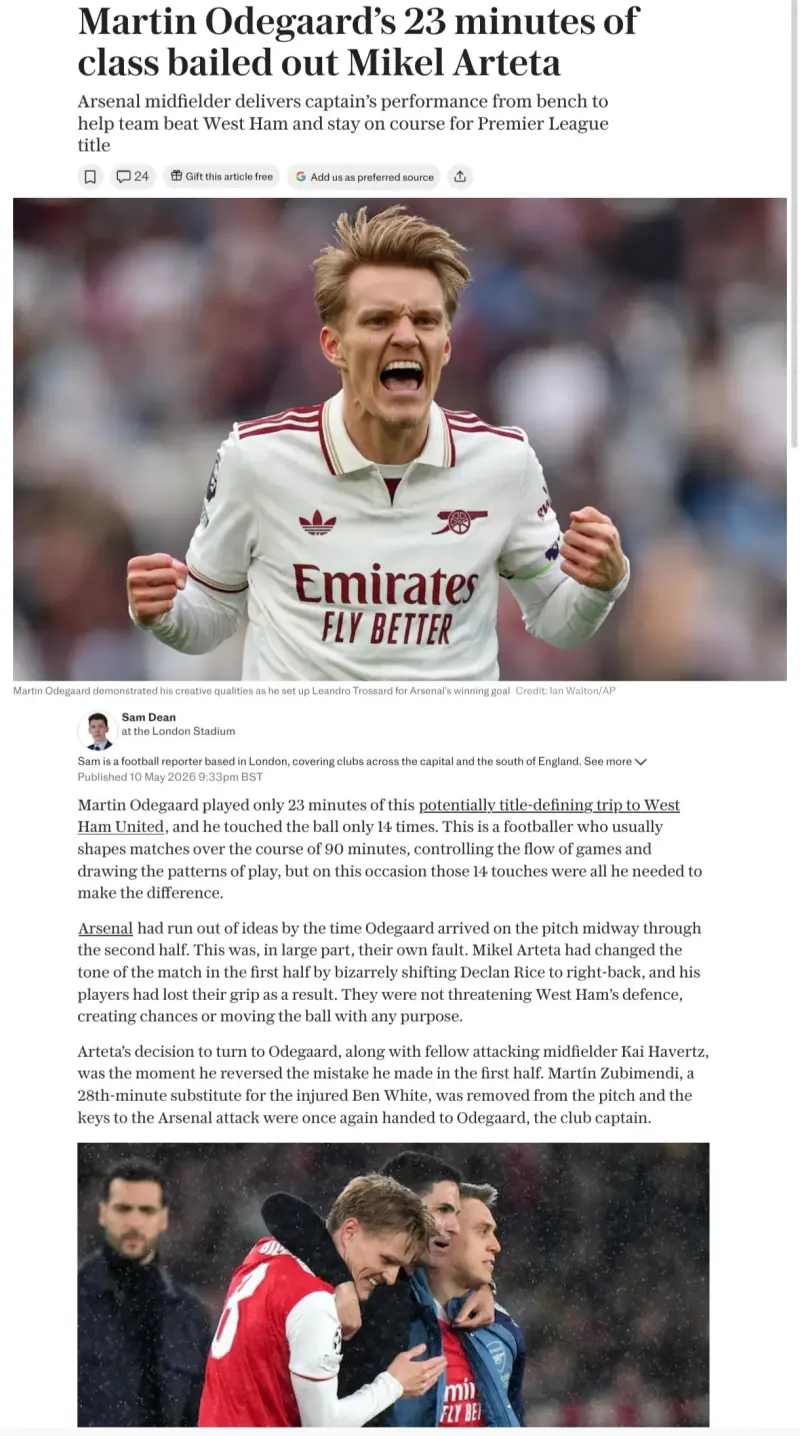
In the away game against West Ham United, this game was enough to change the championship situation. Odegaard only played 23 minutes and touched the ball only 14 times. There is such a core midfielder who can usually dominate the 90-minute game rhythm, control the trend of the game, and sort out the offense and defense. In this game, just with these 14 touches, he changed the outcome of the game.
Before Odegaard came on as a substitute in the middle of the second half, Arsenal's offensive ideas had been exhausted. This was largely due to the team's own tactical mistakes. Head coach Arteta made outrageous adjustments in the first half, moving Rice to the right back position, completely disrupting the rhythm of the game. Arsenal players were thus out of control. The team could neither pose a threat to West Ham's defense, nor create effective opportunities, and its passing was aimless.
Then Arteta replaced Odegaard, and at the same time sent in attacking midfielder Kai Havertz. Until this moment, the tactical mistakes in the first half were corrected. In the 28th minute, Ben White was substituted due to injury, and Subimendi came on as a substitute. In the second half, Arteta replaced Subimendi again, handing Arsenal's offensive baton back to captain Odegaard.
Affected by the ups and downs in his physical condition and the addition of the team's new aid Eze, Odegaard's personal journey this season has been full of twists and turns. However, there is no doubt that he is still Arsenal's number one offensive playmaker. When it comes to flashes of creativity, vision of the pitch and the ability to deliver deadly scoring opportunities, there is no one else in Arteta's squad who can match him.
In the 81st minute of the game, Odegaard kicked a through ball. This through ball was particularly penetrating. It tore apart West Ham United's defense and accurately hit Madueke's running route. In the 82nd minute, Odegaard sent another pass to Havertz in the penalty area. This pass was of a very high standard and was very subtle.
Just one minute later, in the 83rd minute, Odegaard took the ball and quickly rushed into the penalty area. He and Rice cooperated like hitting a wall, and then assisted Trossard to successfully score the winning goal. He had deliberately paused before passing the ball to Trossard. There is a pause, and the ball is easily smashed, waiting for the space to appear. This detail is very crucial. When explaining after the game, he said, I saw Trossard's position, and I also heard his voice calling for the ball, but I need to adjust to a better passing angle.
Within a three-minute period, there were three top-level flashes of inspiration, which successfully secured three points for Arsenal. This is exactly the kind of leadership that Odegaard has shown: being able to drive the team in the forward direction and create scoring opportunities on the pitch by himself. He has never been the kind of captain who relies on loud shouting to boost the team's morale, but in this victory, he has never relied on shouting, but on actual technical standards. At the most critical moment of the game, when the ball came to Odegaard's feet, he steadily showed his top level.
Former Arsenal striker Ian Wright commented on Sky Sports, saying: "The match scene was extremely chaotic and disorderly at a certain period, and the overall competitive level was greatly reduced. To be honest, the one who could really stabilize the situation and show a top performance was Odegaard who came on as a substitute. The pass that assisted Trossard was exactly the top level needed at this critical moment that determines victory or defeat."
In the next few days, Arteta will inevitably carry out review analysis work to think about why he made such a serious mistake when he made his first substitution adjustment. In the 28th minute of the game, Ben White was injured and lay on the ground. At that time, it was generally believed that Mosquera would be the most suitable replacement. However, Arteta made the choice to let Soubimendi enter the midfield, and also forcefully moved Rice to the right back position.
In the 28th minute, White was injured. Prior to that, Arsenal had completed 9 shots, but West Ham United had zero shots. However, after this substitution, until the end of the half, Arsenal only completed 1 more shot. On the contrary, West Ham United had two shots. The team, which always had the upper hand in controlling the entire field, became passive in an instant, without strength, and lost support for forward and backward moves.
At first the game went off track, and the situation persisted until Odegaard played the game and the game returned to normal. Odegaard said after the game: "My responsibility is to get the ball, stabilize the key process of the rhythm of the game, and consciously take the initiative to create opportunities. Find specific moments that can win the game, and in the end we achieved this goal. I can really feel that the team had great difficulties in organizing an effective offense at that time. I just wanted to take the initiative to get the ball and then promote the team's offense. Coming on as a substitute was to stand up bravely and change the overall situation of the game at that time."
Assuming that Arsenal finally succeeds in winning the Premier League title in the next few weeks, then this game will most likely be remembered only for the controversy over the VAR penalty before the end. However, in this game that played a key role in the championship, Odegaard's role should never be underestimated or weakened. He came on as a substitute at a dangerous and difficult moment, supported the team with his captain-level performance, and saved the game.

Author:Sam Dean
In the away game against West Ham United, which could change the championship situation, Odegaard only played 23 minutes and touched the ball only 14 times. This core midfielder who used to dominate the 90-minute rhythm, control the trend of the game, and sort out the offensive and defensive context, changed the outcome of the game with just these 14 touches of the ball.
Before Odegaard came on as a substitute midway through the second half, Arsenal's offensive ideas had been exhausted. This is largely due to the team's own tactical mistakes. Head coach Arteta made an outrageous adjustment in the first half, moving Rice to the right back position, completely disrupting the rhythm of the game and causing Arsenal players to lose control. The team was unable to pose a threat to West Ham United's defense, failed to create effective opportunities, and passed the ball without purpose.
Arteta then brought on Odegaard, along with attacking midfielder Kai Havertz, and it was only at this moment that he corrected the tactical errors of the first half. In the 28th minute, Ben White was replaced due to injury and Subimendi came on as a substitute. In the second half, Arteta replaced Subimendi and returned Arsenal's offensive baton to captain Odegaard.
Affected by the ups and downs of his physical condition and the addition of new team player Eze, Odegaard's personal journey this season has been full of twists and turns. But there is no doubt that he is still Arsenal's number one offensive organizer. In terms of flashes of creativity, vision of the pitch and ability to deliver deadly scoring chances, no one in Arteta's squad can match him.
In the 81st minute of the game, Odegaard sent a penetrating through ball, tearing apart West Ham United's defense and accurately hitting Madueke's path. In the 82nd minute, he sent Havertz a superb pass in the penalty area.
Just one minute later, in the 83rd minute, Odegaard dribbled the ball into the penalty area, hit the wall with Rice, and assisted Trossard to score the winning goal. He deliberately paused briefly before passing the ball to Trossard, spiked the ball lightly and waited for an opening to appear. This detail was crucial. He explained after the game: "I saw Trossard's position and heard his call for the ball, but I needed to adjust to a better passing angle."
In three minutes, three top-level flashes of inspiration sealed three points for Arsenal. This is exactly what Odegaard’s leadership style is: driving the team forward and creating goals on his own on the field. He has never been a captain who relies on shouting to boost morale, but this victory has never relied on shouting, but on solid technical standards. At the most critical moment of the game, when the ball came to Odegaard's feet, he steadily showed his top level.
Arsenal star and former striker Ian Wright commented on Sky Sports: "The game was very chaotic for a time, and the overall competitive level was greatly reduced. To be honest, the one who can really stabilize the situation and perform at the top level is Odegaard who comes off the bench. The pass that assists Trossard is exactly the top level that is most needed in this decisive moment."
In the next few days, Arteta will definitely review and analyze and reflect on why he made such a serious mistake in his first substitution adjustment. When Ben White was injured and fell to the ground in the 28th minute, the outside world believed that Mosquera would be the best replacement. But Arteta chose to let Soubimendi enter the midfield and forced Rice to move to the right back.
Before White was injured in the 28th minute, Arsenal had completed 9 shots, while West Ham had zero shots. But after this substitution, by the end of halftime, Arsenal only completed one more shot, while West Ham United shot twice. The team went from being in control of the whole game to becoming passive and unable to advance or retreat in an instant.
It wasn't until Odegaard came on that the game got back on track. Odegaard said after the game: "My task was to take the ball, stabilize the rhythm, and actively create opportunities. Find the moment to win, and we finally did it. I could feel that it was difficult for the team to organize an effective offensive at the time. I just wanted to take the initiative to get the ball and advance the offense. When I came off the bench, I had to step forward and change the situation."
If Arsenal finally wins the Premier League title in the next few weeks, this game will most likely only be remembered for the controversial VAR penalty before the end. But in this crucial battle for the championship, Odegaard's role should never be underestimated or downplayed. He came on as a substitute in critical moments, carried the team with his captain's performance, and saved the game.